I am staying at Onda Surf hostel. Every place in Taghazout seems to be a surf hostel.
If you don’t surf, don’t do yoga, don’t sketch or at the very least are not half way through writing a book, why are you even here?
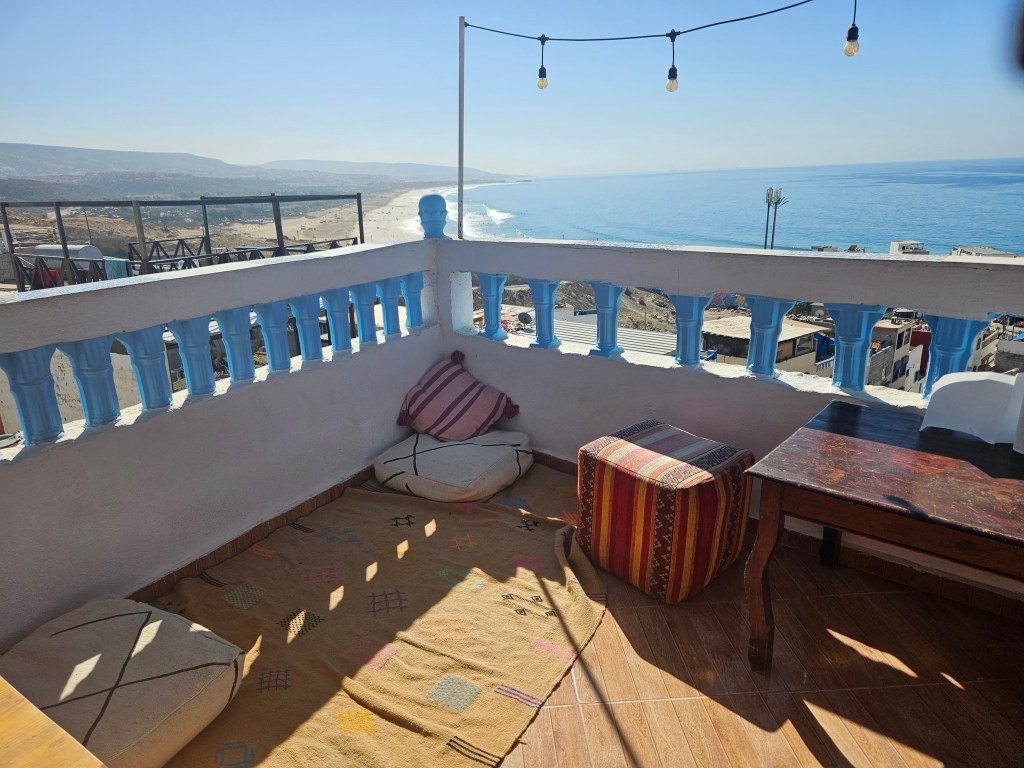
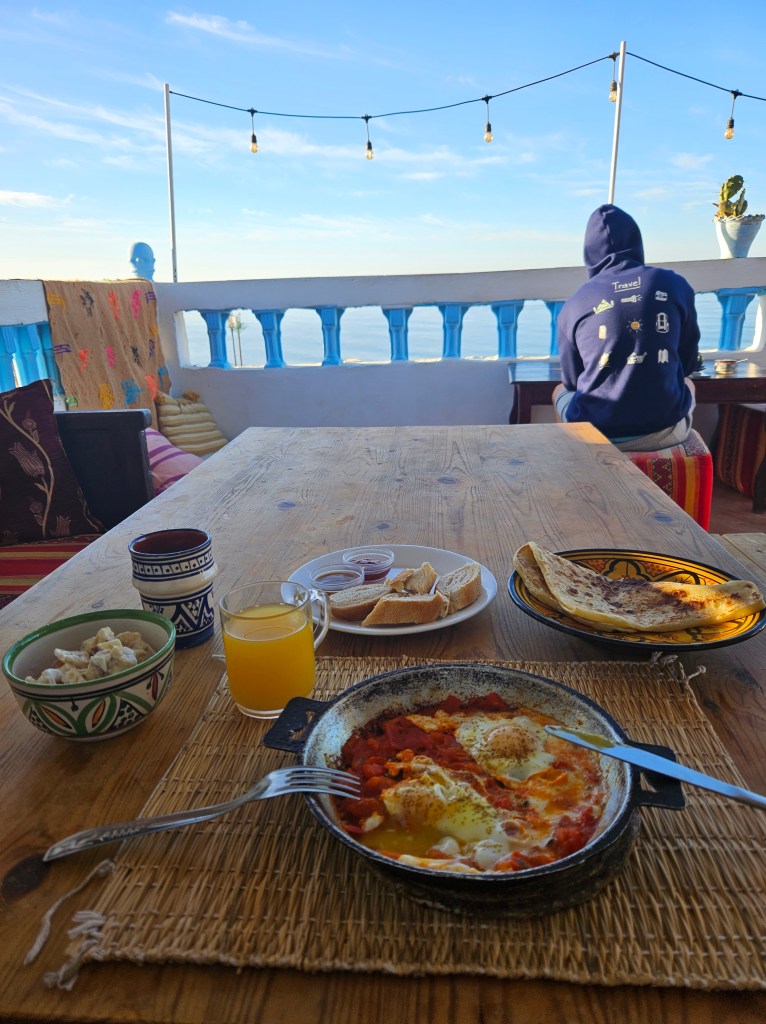
Onda Surf offers the perfect view of the sea and a long stretch of the Sable D’Or beach. Additionally, I was tricked by booking.com clever photography of Onda’s dreamy balcony into thinking this was going to be my private balcony. It is not. It’s a communal rooftop, a focal point of every surf hostel in Taghazout. Rooftop is where breakfast is served, from 9am to 10.30. Rooftop is where guests bring their sketchbooks, their George Orwells, and their surf stories. It’s where they mingle. It’s where I watch them and where I write.
It’s also where I am most acutely aware of my age, because no matter how earnestly my son tries to convince me otherwise, hostels are ruthlessly agist, even if they do not mean to be. They make me feel I had missed the vibe by 25 years, give or take a few.
In the evenings, I loiter on the rooftop anyway. I come up every night after dinner to make my Lipton Yellow Label.
I align my tea time with the communal dinner time, which gives me a chance to eavesdrop shamelessly whilst my tea mug gives me a reason to be here and the feeling that I belong on the rooftop too. Almost.
The other guests are all surfers, they come from all over Europe. They have strong bodies, piercings, tattoos, and flawless skin. A lot of them smoke, which was a surprise. They wear cool baggy clothes and are all so bloody young. Quite a few of them are here on solo adventures, with no definite end date. They are living their best lives, and they use the rooftop dinner time to swap stories of how their day went.
They are friendly to me, and we have had some perfunctory chats, but I feel acutely out of place. Not badly enough to give up my rooftop tea time, but pretty awkward.
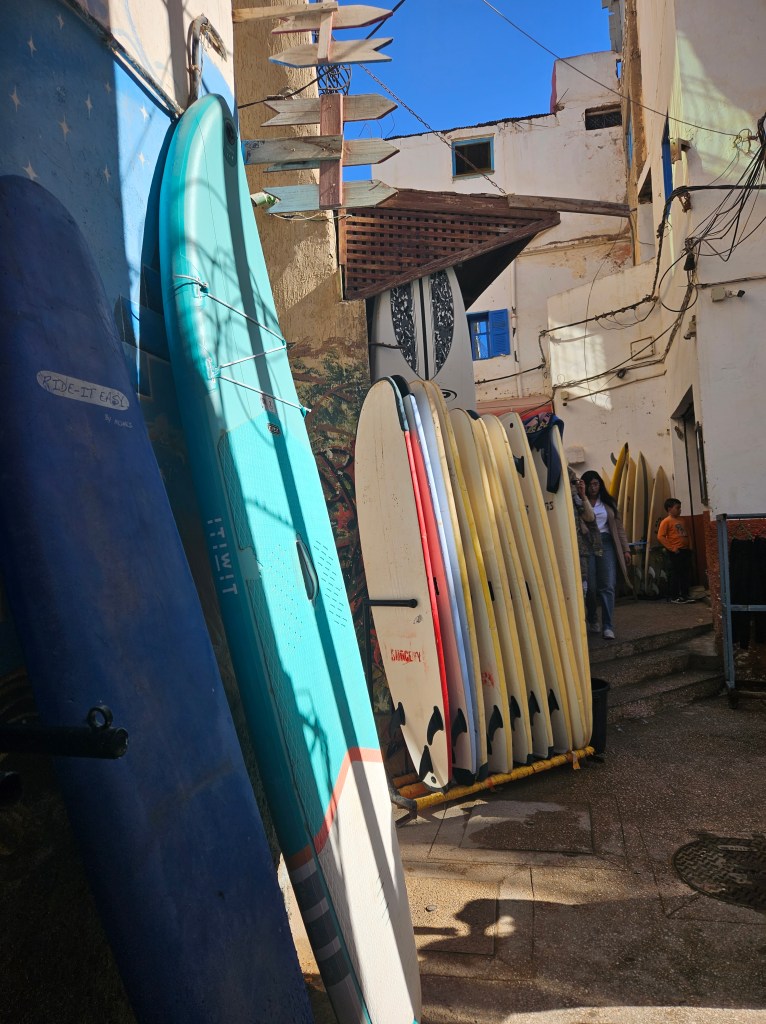
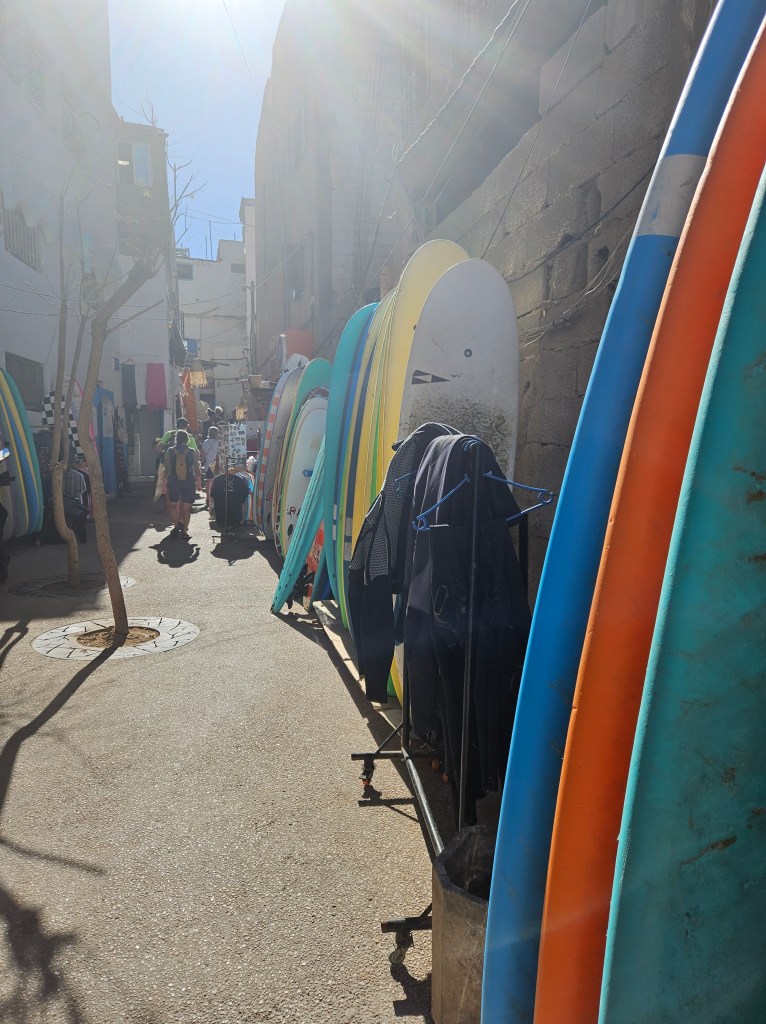
Taghazout beach is a beginner surfer’s paradise. Surfboards are everywhere, and surfers get in your way, cut in front of you along narrow winding streets of Taghzaout, akin to cyclists in London.
They give themselves the right of way, and if you know what’s good for you, you do not argue with a surfboard.
Today I went to Anchor Point, some 20 minutes walk out of town in the opposite direction to the vast long beach on one end of it. Do not ever ask me for directions.
I was told Anchor Point was where more experienced surfers strutted their rubber-clad stuff, so I thought I’d check it out.
I perched myself on a comfy rock, and stared at the sea littered with black figures gyrating acrobatically in gusts of wind. It took me two hours to realise that my brain had not registered a single full surf run. I totally zoned out and could not zone back in.
I got up and walked back to the village. It was time for another cappuccino.
Taghazout has a vegan cafe, called Red Clay. I made a mistake and asked for normal milk with my cappuccino, but normal turned out to be oats milk at the Red Clay.
Coffee, orange juice, fruit salad with yogurt arrive, followed by fried eggs, and several pieces of baguette. Then a plate of three American pancakes drenched in syrup is also put in front of me. I say, no thank you, it’s too much. She takes the plate away.
– Do you want a Moroccan pancake instead?
– Are Moroccan pancakes the ones they sell by the mosque?
Did I really just say that? Why did I say that? I don’t want any pancakes, the breakfast is huge as it is.
– Yes. Do you want one?
– Yes please.
OK, so breakfast confidence needs work. Until then, I can see myself fold the m’smen, that’s the name of the Moroccan pancake, in half, and sneak out of the rooftop with it in my hand every morning.
I took the pancake to the beach with me today. It might come in handy later.
After breakfast, a beach walk. The beach is beautifully empty at 10am.
I entertain myself by playing out a never to happen conversation with the young Taghazout butcher in my head.
I Google translate ‘When is the next time you are going to open the cow’s head, s’il vous plait?’ into French. I say it aloud a few times. Duolingo content creators would have been proud of me.
I cut the walk short, because today is hamam day. My son arranged a pick up for the hamam at 12pm. The drive is 10 minutes away from the beach and into the mountains.
Hamam is not for everybody. If you are coy about bearing it all, and I mean, all, in front of strangers, if you have an issue with the said strangers kneading and prodding every inch of you, don’t do it.
If you are uncomfortable about anything which might feel remotely sensual, even when it really never is intended that way, don’t do it.
If you have a low pain threshold, do not do it.
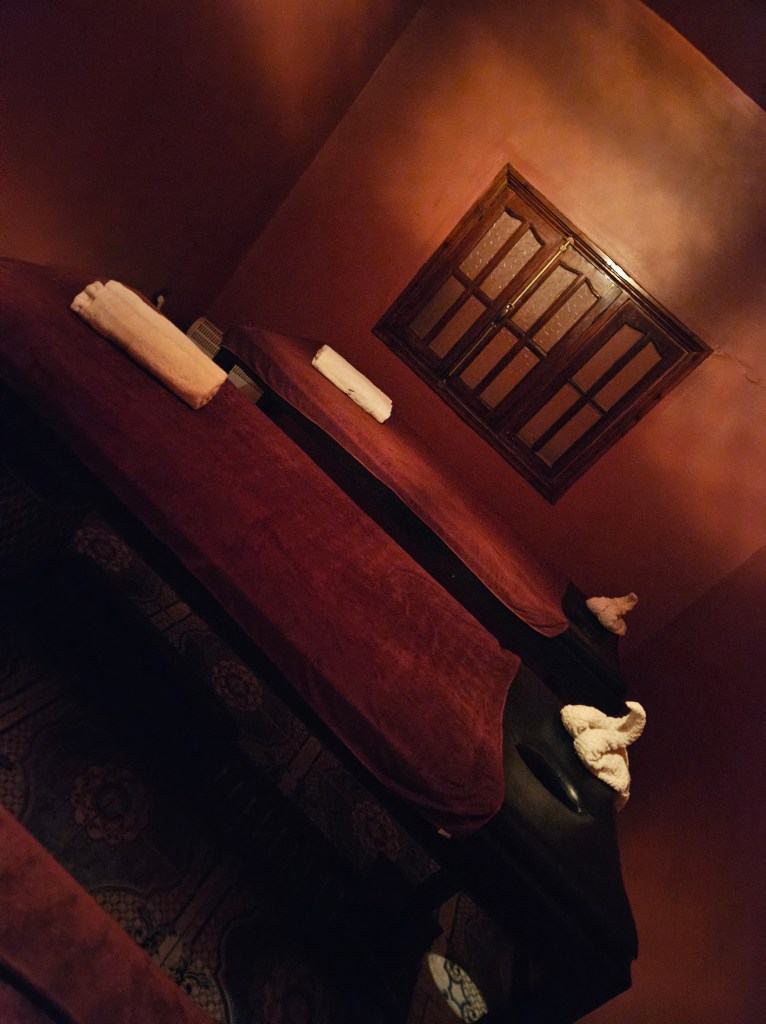
After I strip off to my bikini bottom, it’s off to the steam room, where I lose the panties too, to be replaced by the skimpiest most useless paper thong. It’s a bit late to worry about my modesty anyway. The very polite very considerate young lady smothers me in some brown goo, answers my quering look with a curt ‘savon’. Next, I am laid down on a marble slab and she sandpapers me methodically from my toes to my chin.
When I am all scrubbed down to the bone, she hoses me down with pleasantly hot water, and smears another goo all over me, this time with a strong aniseed smell. I want to ask her what it is, but the only French sentence I can think of is, when is the next time you are going to open the cow’s head? I give the conversation a miss. Second round of prodding and a few minutes alone in the steam room follows.
After that, the paper thong comes off, I am given a bathrobe to walk to the next room. In there, another very polite lady takes the robe off my shoulders, wraps me up in a towel and points to a massage bed. I lie down on my belly, face goes through a hole and then she asks me, ‘massage strong, medium or relaxing?’
Strong, please, I say, God knows why.
Who needs enemies when I have myself.
Strong hurts a lot, but it’s also strangely enjoyable. I wish I had taken paracetamol beforehand.
To round up the experience, I am offered a glass of Moroccan green tea and a couple of biscuits. I have earned every crumb.
My son was sick today, so my supported solo travelling experience ended up being unusually unsupported.
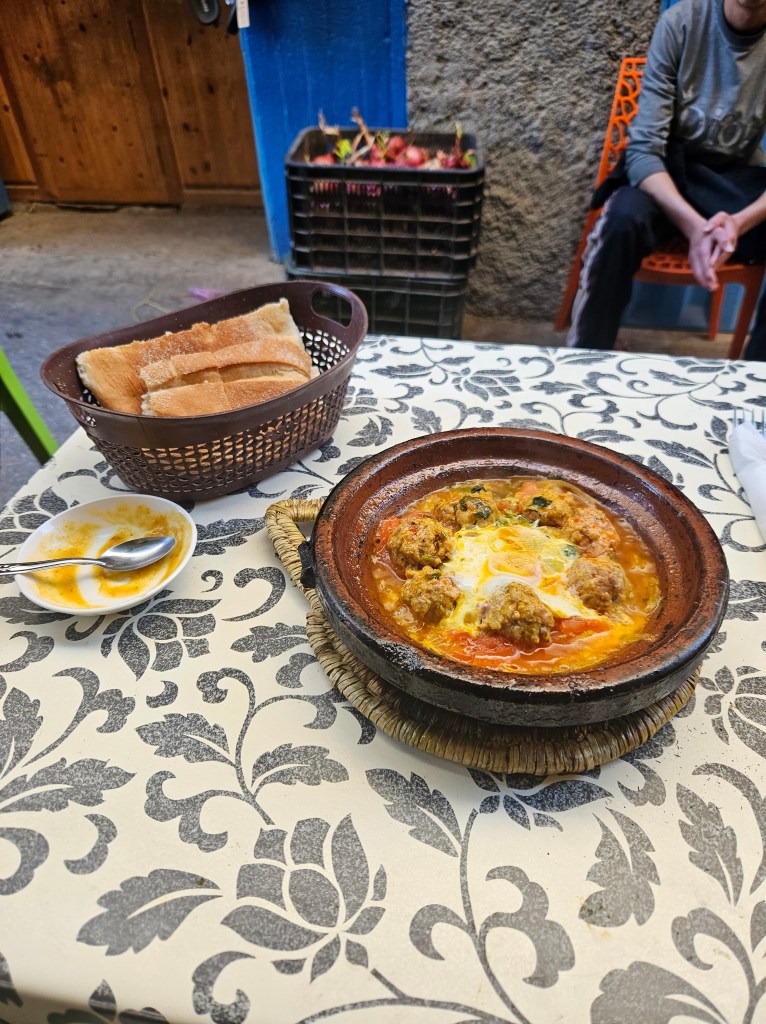
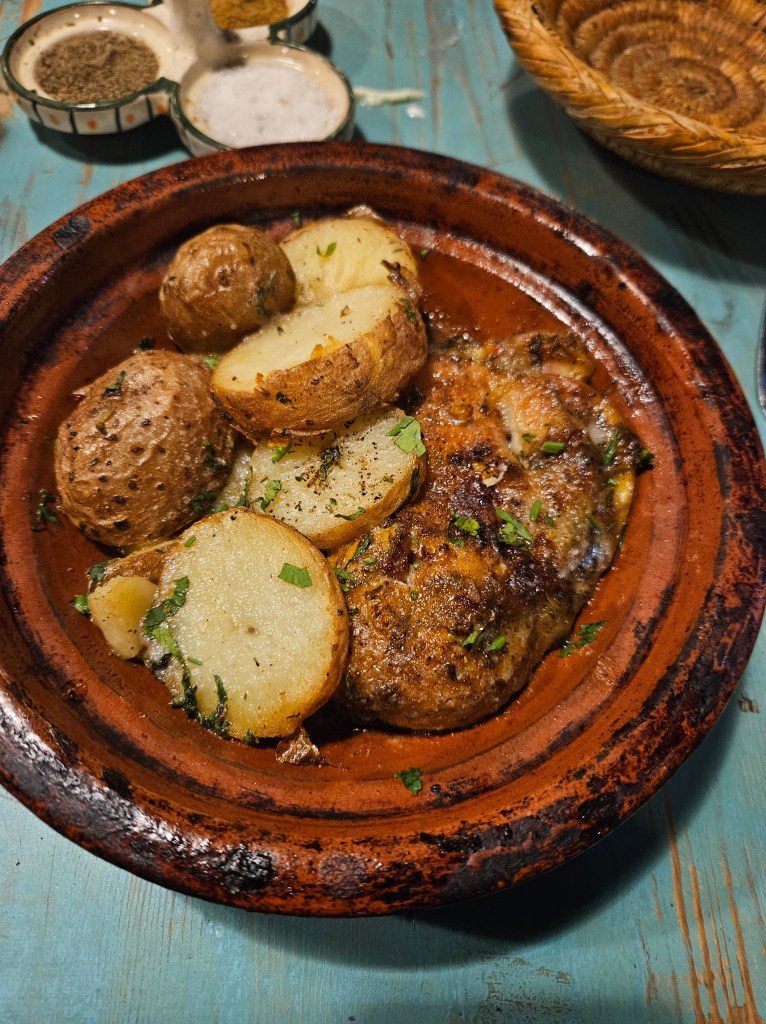
I went to a restaurant for lunch all by myself. Cheated a little, because we went there together yesterday, so Abdullah the manager recognised me, which meant I could pretend I was lunching at an old friend’s place. I ordered a tagine, and when it came, I asked one of the waiters to take a photo of me, so I could send it to my family to show that I was able to survive perfectly fine on my own. At this point, an old man in the corner of the restaurant asked what was going on. Abdullah explained. The old man sent one of the waiters to fetch a sisal cross body bag from a wheelbarrow, apparently part of his merchandise. He insisted on gifting it to me and absolutely refused to take any money. I thanked him and took the bag. Sometimes it’s best to accept a gift with a smile. I don’t know why he gave me the bag. He might have felt sorry for me eating all alone, or maybe I am his wife now. Fifty fifty.
Today’s undisputed highlight goes to watching a cow’s head getting de-brained, if that’s the correct term for it.
As I set off on my first solo stroll around Taghazout, a half-skinned cow’s head, ears still on, caught my attention. I subtly edged closer to where the head sat on butcher’s block, and casually hovered and lingered, as the young man made a hole in the cow’s forehead with a few swift hacks of an axe. He then removed the brain, perfectly intact, and scooped it into his hand. Glued to the spot by this sight, I stared at the neat folds of the perfectly spherical brain until the butcher started throwing me dirty, lady you ok? sideway glances.
Other things happened too.
On my first full day in Morocco, I woke up to the sound of a rooster fine tuning his vocal cords, followed by a call to prayer, followed by motorbikes revving up all around.
My solo travelling experience was put to the first real test this morning. Breakfast is served on the rooftop from 9.00 till 10.30. I was there at a stroke of nine and proceeded to spend the next few awkward minutes fidgeting around the open kitchen area, not sure what to do. I was saved by a softly spoken young woman, who greeted me and asked me if I wanted tea or coffee with my breakfast. Structure and order thus restored, I could sit down and eat.
After breakfast, the day sort of whizzed by punctuated by a series of short activities. I walked up and down Taghazout Sable D’Or beach twice, got my feet wet in the cold sea, took photos of camels, cats and dogs, had coffee, walked a bit more, had tagine lunch with my son, had another coffee and a banana milkshake, eyed up some possible gifts trinkets, watched my son surf, watched the sunset, had dinner, had an after dinner pancake by the mosque, said goodnight to my son and went onto the rooftop of my hostel. As I climbed up, I got suddenly struck by a genius idea that since they were serving dinner, I could ask them for a cup of tea. They were very happy to serve me tea, as long as I was happy with Moroccan mint tea. I was not. I climbed five floors down, went to the shop next door to my hostel, and without holding out much hope I asked if they had tea. Moroccan tea? No, not Moroccan. This one? The shopkeeper pointed out to a box of Lipton Yellow Label. Happiness is a box of Lipton Yellow Label in Taghazout! Climbed the five floors to the rooftop in seconds, fine, a minute per floor, and asked the young man working there if I could have this tea please. He tried to dissauade me at first, and said it was too late in the day for black tea, and I might have trouble falling asleep. Bless him. Half an hour later, with two mugs of Lipton Yellow Label in my belly, 26,846 steps under my belt, my day two was truly complete.
Inspired by a friend who had recently left her well established London life and went to Africa to write and to re-assess everything, I have decided to keep a diary of my trip to Morocco. My trip was booked before I found out about my friend going to Africa, so I didn’t copy her and anyway 10 days holiday hardly gives me the scope for the journey of self-discovery, but she inspired me to write while I am on my break. It might lead to something bigger later. It might not.
I am writing this to myself and for myself, writing for the sake of writing, a gentle stretching exercise after a period of inactivity. To see if I still can, if it flows, if it still makes sense. To me.
I am flying to Agadir today, then it’s off to a village of Taghazout, where my son is spending his winter months. He is cool like that.
Day 1
The holiday is going well.
Except, Weatherspoons at Gatwick North stopped serving Eggs Benedict and Eggs Royale at 11am. Who knew. So it is possible even for me to arrive too late to the airport. Actually. On the day of travel, I live for the moment I get to choose between the Eggs Benedict and Eggs Royale. Oh, well. I have 3 hours before boarding, so I search the whole airport for the eggs, I find a place called The Breakfast Club and have my Royale.
I’ve had better. My eye catches the price on the recept. £23.50, including the smallest cappuccino in the South East. Oh, well.
Next, my very slick very stylish also very not 45 cm x 30cm x 20cm Sanquist backpack failed the Cinderella glass slipper test and didn’t fit into the metal cage for small backpacks. It was painful to watch as it got stuck half way down, Boris-on-the-zip-wire style.
Oh, well. Win some lose some. I knew I was taking chances. Travelling light was never my thing.
Onwards and upwards. No children on the flight. Not one. Yay!
Spoke too soon. There was one. ‘I am hungry’, the mini-person announced as she waddled past me, stuffing her face from an open bag of Cadbury’s originals Sugar Rush.
I am in 20F, window. I am next to two well-nourished ladies. I battle for the arm rest with the 20E. I lose. The two of them sip white wine and Sprite like the pros.
We are cruising over Spain, we are told, as I write this. The white cotton wool fluff above Spain hides the rest of Spain.
The 20E and 20D are on their third small bottle each.
I can’t decide how I feel about this solo travelling business.
Window seat next to strangers is all well and good, but what if need the bathroom. The air between me and the 20E is still thick with the recent armrest hostilities. Their tables are littered with wine bottles, cans of Sprite, chocolate wrappers and plastic cups. Folding them to let me pass would mean a fuss. I amuse myself by playing out a scenario whereby I nimbly hop from armrest to armrest to get out.
They have bought crisps now so the smell of white wine mixes with the whiff of ready salted. They reach into their crisp packets with slow synchronicity. If only I could see Spain.
The dulcet tones of Joan Baez in my headphones make it all soothingly unreal.
I sleep.
I wake up with a panicked thought that I must wake up the foster kids for school and college.
The 20E is sinking her teeth into a Snickers bar.
I have given up on Spain, if indeed we are still over it.
I need this holiday so badly.
Half an hour to landing. I read five pages of Flowers for Algernon, had a lukewarm Easyjet tea, and am now on my peach tea bottle. It’s such a bliss being stuck in my cramped 20F, with nothing to do, no emails, no calls, no Tesco, no hungry cats, no arrogant teenagers, no wind, no rain, nothing.
Coastline.
The flight flew by. Three and a half hours.
Passport control. The queue is something else. There is an option for Rapid queue for 300 dirhams. Not many takers. We crawl forward.
A blue rinse lady from the plane strikes up a conversation. Turns out my glass slipper backpack attracted some attention, and now a small group of my fellow Easyjetters want to know if I was the woman who was pulled over.
Did they let you go? Well, clearly.
Did you have to pay extra? Yes.
How much?They roll their eyes in horror and disbelief.
My rebellious side takes over. ‘I don’t mind, I don’t care’.
Free airport WiFi is a tease. I am yet to find an airport where WiFi works for longer than five seconds.
None of this matters any more. I am outside.
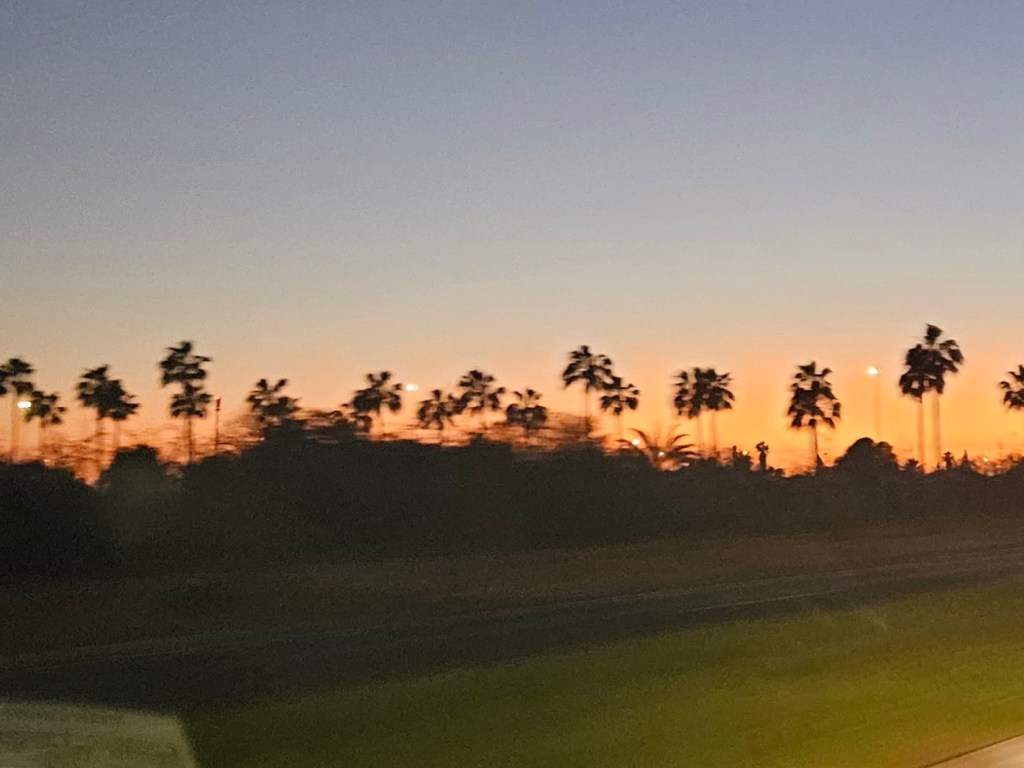
A crowd of taxi drivers with signs awaits. Looking for my name. Nope. No Ania Heasley anywhere. Did three rounds, no joy. Found somebody with Sundesk sign. That’s where my son lives, so looking promising. Yes! He is my man. Muhammad is a taxi driver of few words. It’s now dark outside, getting darker by the minute. Obligatory silhouettes palm trees and the last blood orange vestiges of daylight. Sewage smell as we drive. Exciting stuff.
I kept asking Muhammad questions until finally he gave in and told me everything that his limited English allowed him to say.
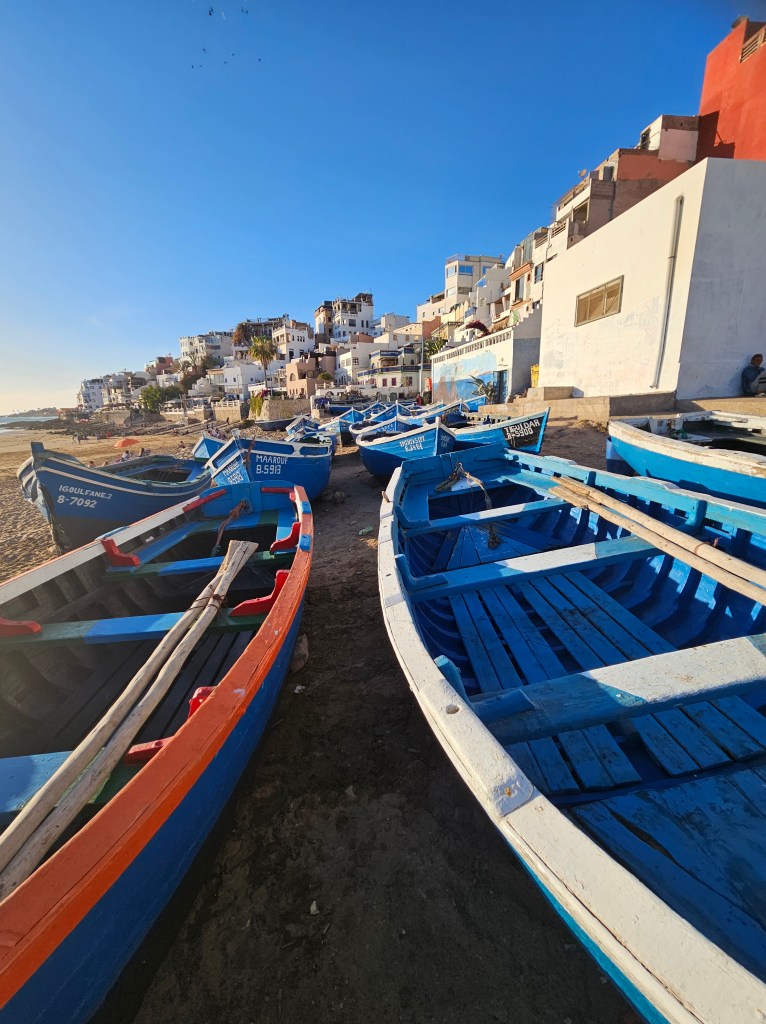
One hour later, I met Matty and we went for chicken tagine, followed by whirlwind tour of Taghazaout. Proper first impression will need to wait till tomorrow, but for now I can say it’s a pretty laid back place, chilled, chaotic, warm, did I mention chilled, cats are everywhere, trendy looking tourists stroll around, the sea is 5 minutes walk away, can’t wait to see it all properly in the daylight.
My room at Onda Surf hostel has three beds, towels, blankets and a private bathroom with toilet and shower room. No kettle. I didn’t think there would be one. Coffee at communal breakfast on the rooftop at 9am.
My daughter and I continue our borderline obsessive quest to get to the bottom of the music legend called Bob Dylan. Not his actual bottom, that would be inappropriate. And gross.
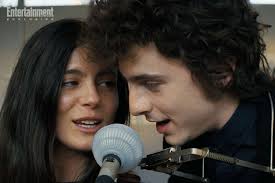
After seeing the man himself in concert in Liverpool in November last year (yes, really, he is still alive), today, we saw Timothee Chalamet in A Complete Unknown.
We both agreed that today’s experience was much more enjoyable. At first sight, baby face Chalamet is not the most obvious choice for the role, but he had grown on us by the minute. The transformation was gradual, as he acquired his iconic brown leather jackets and I am too cool for my boots mannerisms. By the time he rode into the sunset on his motorbike, 2 hours and 20 minutes later, Timothee WAS Bob.
As the more attentive readers of my writing efforts might recall, my daughter and I had been bearing a grudge against Bob since that evening in Liverpool. My daughter and I, let’s call my daughter Alexia because that is her name. So, Alexia and I were properly peeved when Bob Dylan had not sang a single one of Bob Dylan Greatest Hits for us.
Little we knew that we were by no means the first ones to feel cheated by Bob the Great. We learnt today, with a raised eyebrow, that Dylan started the trend of not giving cat’s whiskers about what his audiences came to hear at Newport Folk Festival in 1965. He shocked his fans there by playing an electric guitar and debuting his rock’n’roll sound when thousands expected to sing along to his folk staples. Nearly 60 years before not singing Mr.Tambourine Man at the M& S Arena.
We felt a little less special as it looked like disappointing his fans had been Bob’s party trick since either of us was born, and that is a very long time ago!
Then again, perhaps the right way to look at it is to see ourselves as privileged enough to be part of Bob’s inner circle of the fans he goes on pissing off through the decades.
Apart from being personal to us, the film was also beautifully nostalgic, full of cigarette smoke and the musical greats of the early 1960. My top scene was Bob’s duet with Joan Baez. And finally, Edward Norton for supporting actor gong at the awards season, please.
Last weekend, my daughter and I travelled from two opposite corners of our beautiful island to converge in Liverpool to see Bob Dylan in concert.
We had been looking forward to this day for months, seeing it as probably the biggest musical event of the year, bar my daughter’s own summer gig at the Bread&Roses, Clapham, naturally.
We both had a brilliant weekend in Liverpool. Royal Albert Dock had everything we could wish for, the evening light show, the Sunday Market, the waffles and ice-cream at the Pumphouse, what’s not to like.
The Beatles open top bus tour was excellent. James, our guide spoke and sang throughout, we took selfies at Penny Lane, saw the barber’s shop and the bank on the corner from the song, we were treated to endless anecdotes about how the four local lads became the Fab Four. The veracity of the stories might be difficult to verify, but they were fun to listen to nevertheless.
Later on, the sirloin at Miller&Carter was dreamy.
Oh, yes, Bob.
The event was advertised as phone free. I looked up how this was going to be enforced, and found some unlikely reddit responses how every single phone was going to be put into a pouch, locked magnetically for the duration, and then released on exit. Yeah right. There was no way they were going to give out 10,000 pouches. They did. They really did.
No photos, no recording inside the M&S Bank Arena. No selfies of the two of us wriggling in eager anticipation in our seats. Oh well, it will be worth it, we thought. It wasn’t.
There was no opening act and Bob came on bang on time at 7.30. He stayed behind his piano for 98 out the 100 minutes of the concert. He got up twice only to return quickly to the piano, grabbing onto its side as if to relieve a momentary sciatica flare-up. I am being unkind.
He looked and sounded same as ever, old and raspy.
A number of fans wore brown leather jackets. Bob opted for a glittery blazer.
The set consisted entirely of obscure, unknown, un-catchy songs from his 2020 album. For the first half hour everybody was on his side. He was Bob Dylan after all. Surely, he would include a few of his greatest hits somewhere there. He didn’t. Not one. After 100 minutes on the dot, he did his final harmonica piece and lights went up. No encore. No ‘Hello Liverpool, how are you doing’, no hello at all.
His detachment from the reality of his own legend and from what his fans wanted to hear was so complete, he could have been a politician. Of course, at 83, he still has plenty of time to run for president of the country he hails from.
My daughter and I left the venue as underwhelmed as everybody else in the near capacity crowd.
As we stepped outside, our mobile phones were released from lockdown with one swift click of a magnet. Perfect timing as it happened, because moments later we experienced the first thing worth recording. Outside the arena, Frankie, bless him, was doing exactly what we had all been waiting for all night. He sang Bob’s greatest hits, the guitar and harmonica at the ready. Tambourine man, Blowin’ in the wind, the times they are a-changin, the lot. The crowd around Frankie thickened by the minute, smiling, swaying, singing along. I overheard one lady of suitably advanced years, say ‘this is so much better than the shite in there!’ We stayed as long as we needed to get the Bob Dylan fix we came to Liverpool for. Thank you Frankie!
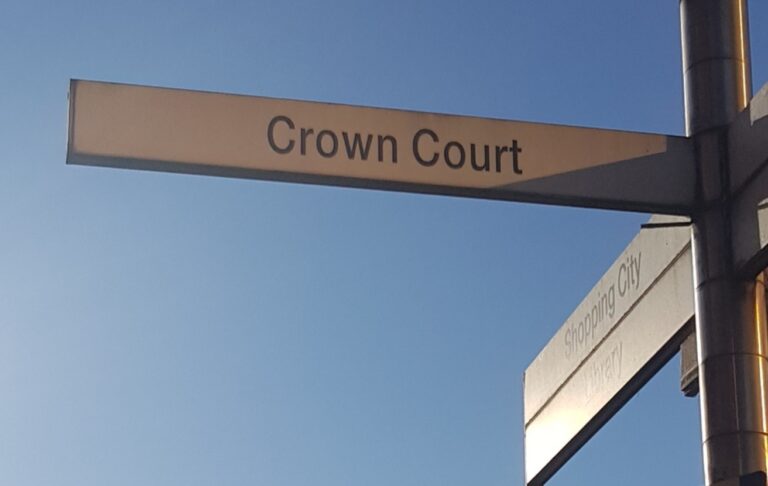
A barrister, a police officer and an interpreter walk into a Crown Court.
If this sounds like the beginning of a bad joke, it’s because it is.
The barrister and the police officer whip out their phones, flash their QR codes and are whisked through security, no questions asked.
The interpreter puts her bag onto a tray, is asked to empty the entire contents of the bag, and to open every zip pocket of her wallet and her make up bag. Her lanyard with the National Register of Public Service Interpreter badge lies crumpled among her belongings, making no difference to the security procedure.
Monday mornings are particularly testing when fresh cohorts of jury members descend on Crown Courts all at the same time, as per their jury summons letter, which means queues of upwards of 40 minutes are not uncommon.
Once past security, the interpreter is reunited with the barrister, who has been patiently waiting for her, so they could go to the cells and have a pre-court conference with their client, which they are unable to do without interpreter’s assistance.
Three highly skilled professionals whose attendance is fundamental to the running of court proceedings, and yet only two of them are treated as such.
The Crown Court doorstep scenario can be dismissed as a minor inconvenience, but it is symptomatic of the current state of public service interpreting profession.
Public service interpreters play a crucial role in the functioning of UK public services. The police, the NHS, Children Services, Housing Associations, HM Courts and Tribunals Service, the DWP, the HMRC, and many others rely heavily on the competences of public service interpreters in their day-to-day business.
Public service interpreting (PSI) attracts some of the most experienced, highly qualified language professionals in the country.
What is the attraction? Good question.
Answers vary. The job is challenging, keeping the interpreter on their intellectual toes, no two days are ever the same, and the feeling of ‘making a difference’ to people’s lives has no price tag. PSI allows interpreters to gain insights into a vast range of specialisms. Given time, we become second hand experts in pretty much everything, from the role of diatoms in murder scene forensics to post tibial transfer physiotherapy, from colonoscopy bowel prep to aggravated burglary sentencing guidelines, which makes us infuriating know-it-all to friends and family.
So far so incredibly rewarding, isn’t it? You might even be tempted to feel a pang of jealousy. Don’t be.
At the time of writing, PSI is hardly a profession at all. It’s an unregulated industry, a free for all, anything goes chaotic madhouse, a trapeze act with no safety net, a chancers’ paradise and what frequently follows, a recipe for disaster for vulnerable non-English speaking service users.
Interpreters in the UK do not enjoy the legal protection of title, which means that unlike doctors, nurses, midwives, barristers, social workers, chiropodists, or architects, to name a few, anybody can call themselves an interpreter, if they so wish.
This leaves the doors to abuse of title wide open to anybody who believes they have good enough skills to act as an interpreter. After all, as long as you are fluent in another language, how hard can it be.
Registered professions, which enjoy the legal protection of title require their practitioners to be registered with their respective Councils in order to be allowed to practise. The Nursing and Midwifery Council (NMC), for example, is the independent regulator for nurses, midwives and nursing associates in the UK. The registration with the NMC is the condition of practice.
No equivalent exists for public service interpreters.
What does exist is the National Register of Public Service Interpreters (NRPSI). To an untrained eye, the name sounds like this entity would a good candidate to fulfil the same function for interpreters that the NMC does for nurses and midwives. Unfortunately, at the moment, it has no regulatory powers. The best qualified, most experienced interpreters are encouraged to register with the NRPSI, but a lot of them choose not to, as they do not see any quantifiable advantages of spending the annual membership fee. The NRPSI membership is a professional status symbol, but unfortunately not much else at present, as the membership is not a requirement to work for any of the major PSI clients, such as the NHS, the courts, and the police. Several cash-strapped interpreters see it as a vanity badge that they can ill afford in the current economic climate.
As things stand, at the moment, there is nothing stopping an unqualified, inexperienced, unvetted person, whose only credential is fluency in another language, to accompany a vulnerable non-English speaker to a medical appointment, and act as their interpreter. The overworked NHS staff are only too happy to see that their patient has brought their own ‘interpreter’, which means one less thing for them to arrange.
This opens a Pandora’s box of potentially nasty consequences.
Firstly, there is an issue of a code of practice. An unregistered interpreter does not have a code to adhere to. Professional interpreting fundamentals, such as confidentiality, impartiality and performing to the best of one’s skills and ability do not apply to cowboy interpreters.
Second on the long list of issues in the world of unregulated PSI is lack of accountability. In the absence of an entity to impose legally enforceable sanctions, serious errors, omissions, and inaccuracies, which would amount to gross misconduct in a robustly regulated professions, go unpunished.
Anecdotes of incompetent interpreters doing their worst have circulated among practitioners for years.
I would like to share here a couple of examples I personally witnessed, to give a flavour of what can happen.
Example one. Police custody suite booking in procedure. An officer goes through a set of routine questions with a detainee, an interpreter is present.
The officer asks whether the detainee would like to see a duty solicitor. Unbelievably, the interpreter renders ‘duty solicitor’ as ‘deputy solicitor’, which the detainee is not impressed with, and loses his temper, shouts that he knows his rights, and he is entitled to see a proper solicitor, not a deputy, and what the effing eff is a deputy solicitor anyway. An interpreter’s embarrassing mistake causes a routine situation to escalate unnecessarily. I can only assume that the interpreter was unfamiliar with the term duty solicitor and misheard it as deputy. Oops. How on earth did she convince an interpreting agency that she was good enough to interpret for the police? Another oops.
Example two. Physiotherapy consultation. The therapist informs the patient that she suffers from hyper-extension in her knee. The interpreter renders hyperextension as hypertension in the patient’s language, and ‘helpfully’ adds her own explanation to the patient, that hypertension means high blood pressure. The patient is very confused, and more than a little worried about what is wrong with her. Oops.
Harm caused by incompetent, unaccountable interpreters is often more insidious than in our two ‘oops’ stories. Interpreters who undertake tasks above their skill level have been known to go to great lengths to cover up their professional deficiencies by making things up as they go along, interpreting what they think they hear rather than what is being said. They do not ask for clarification or repetition, for fear of appearing exactly what they are, incompetent.
More often than the public has the right to expect, poor interpreting effort resembles the practice we have all indulged in on occasion, of singing the wrong lyrics to hit songs, until we realise, with a tinge of awkwardness that the Rolling Stones did not in fact sing “I’ll never leave your pizza burning”.
Oops. A bit of a laugh, no harm done. Unlike the interpreters mishearing what service providers are saying and running with it even after they realise their mistake.
Public service interpreting desperately needs a robust legal framework, within which interpreters will become accountable for their professional conduct. It needs protection of title with all its consequences. Will I see this within my interpreting career lifespan? I sincerely hope so, although as I am planning to retire within the next few years, so I am not holding my breath.
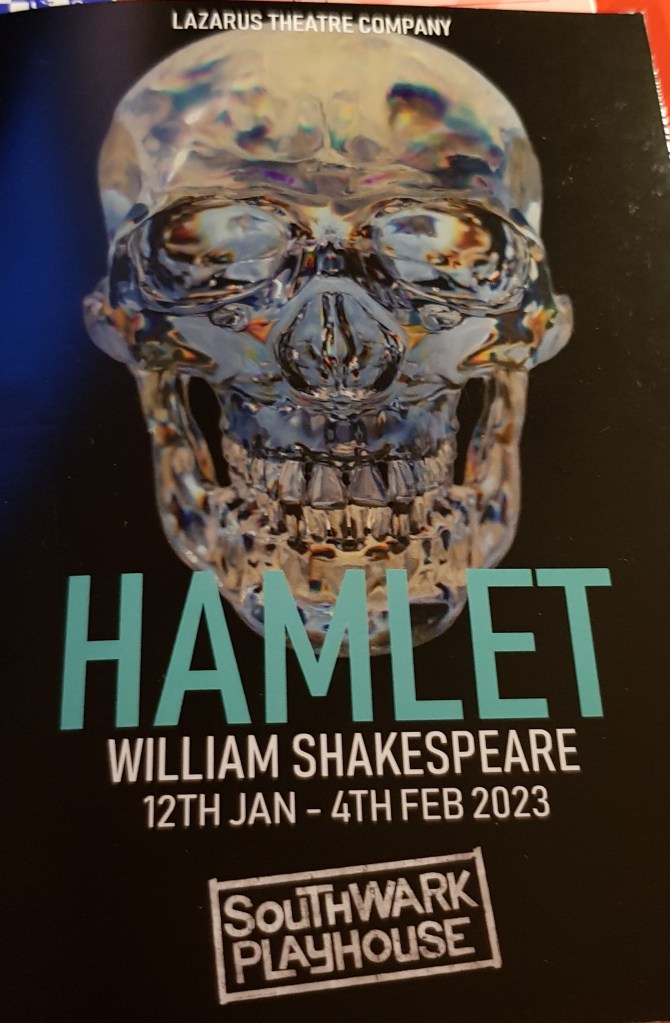
This review contains spoilers, but it does not matter, because I went to see it on the last day of its run, so if you haven’t seen it, you are not going to, and you might have heard already that everybody dies anyway.
Horatio survives. The guy who made it, albeit between the commas, into the famous line ‘there are more things in heaven and Earth, Horatio, than are dreamt of in your philosophy’.
What did you miss?
You missed an unusual production of Shakespeare’s most famous play. Please note, unusual is not used here as a synonym for ‘interesting’, this ruthless one word condemnation of anything.
You missed the shortest meaningful production of Hamlet you are likely to see. Meaningful is important, because I am vaguely aware of a past project by Reduced Shakespeare company, which squeezed 37 plays into 97 minutes, but we can probably safely agree that that was just nonsense.
Southwark Playhouse Hamlet was 90 minutes, which was one of the reasons why I was attracted to the proposition of seeing it. Even if it were very very bad, it would be over in an hour and a half, and I could handle that.
It was not very very bad, but it could have been better.
I did not come to it completely unprepared. In fact, I am going to come clean. I bought the tickets because a week earlier, my 17 year old daughter saw it with her school. They are ‘doing’ Hamlet as part of their English literature course, so it made sense. She gave it a raving gushing five star review, could not praise it enough, she was in love with the production, and everything and everybody in it. She also said that she would have loved to talk to me about it again after I had seen it. So I went.
Highlights and lowlights.
All the actors are ridiculously young. So much so, that you would be forgiven for thinking you had stepped into a school production. Mercifully, it became apparent that it was not a school production as soon as Hamlet spoke. He was good. He was very good, especially when he got angry and mad, somewhere in the middle, and from then on he was pure pleasure. His to be or not to be felt a bit rushed, but then again, everything did, as there was only an hour and a half to play with.
Laertes and Horatio were very good too. So was the actress from the troupe of players, who recited the Pyrrhus and Priam monologue.
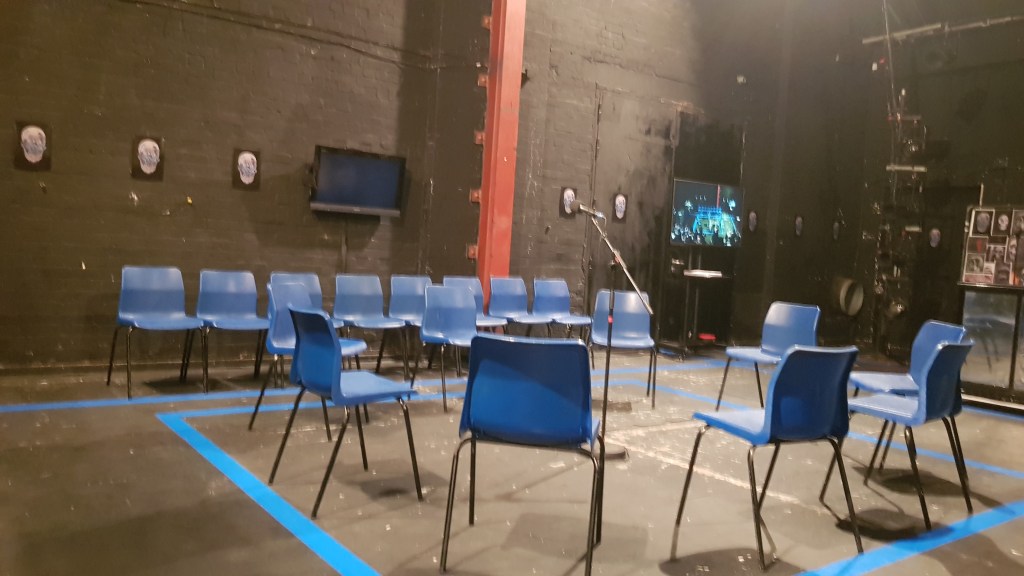
The ghost scenes were a little too shouty for my liking, and the light beams from the torches revealed a disturbing amount of dust particles in the air. If I were asthmatic, I would be reaching for my inhaler.
Ophelia did not cut it for me. I also felt that her walk to the actual toilets at the venue to kill herself, which we watched on TV screens with ominous music in the background, took an unnecessary long time, especially as time was at a premium. We knew by then the only thing left for her to do was to kill herself, so the gunshot could have come quicker.
The condensed form of the production required that big chunks of the text be removed, and this meant that the play descended into a recitation of most famous sound-bites at times.
To the manner born, frailty thy name is woman, the rest is silence, get thee to a nunnery, were all there, but it felt that without the broader context in which they are usually delivered, they lost a large part of their emotional impact and lyrical beauty.
The three characters who disappointed the most, were Claudius, Gertrude and Polonius, simply because of their absence. Only the young generation of characters made it into the cast. It worked well to an extent, but I did miss some deleted parts, such as exchanges between Hamlet and his mother.
I felt Polonius, in particular, was robbed of his role. His character has a few powerful lines, and if nothing else, his brevity is the soul of wit ditty would have served as a fitting motto of the show.
Overall, I am glad I went, it was an ‘experience’, but next time I might be more careful to part with my time and money entirely on the strength of my teenage daughter’s enthusiasm.
3.30pm start time. I spent the whole morning carefully preparing for the mind-boggling, no pause button available, 192 minutes plus adverts plus trailers, cinematic experience. I stopped consuming liquids from 12pm just in case.
Next, I completed a risk assessment questionnaire on the NHS website in relation to deep vein thrombosis. My score was reassuringly low, so off to my lovely local Everyman I went.
Science-fiction and fantasy are not my genre of choice, but I loved the first Avatar’s visuals, and was looking forward to the sequel being equally picturesque.
Aesthetically, it certainly delivered. Every law of physics-defying forest was as magical as the first time round. The creatures’ faces as mesmerising. Am I allowed to call them creatures, or does this make me alienist?
The blue guys were now joined by the pale green water guys. Not straight away, mind you, the introduction and setting the scene took roughly an hour.
‘The Way of Water’. There certainly was a lot of water. James Cameron’s fascination with slow-sinking ships was strong with this one. Some third hour scenes looked lifted in their entirety from the third hour of Titanic, where random items kept sliding down at an angle and people scrambled up, being occasionally hit and crushed to death by heavy boxes and metal poles.
Kate Winslet. A good chunk of the film’s generous running time was taken up by me guessing which character she played, as none of the blue or gree creatures made me scream, OMG, that’s Kate Winslet! Her disguise was complete, the coquille St Jacques, which featured prominently on her forehead, did not aid immediate recognition.
I always wondered what actors got out from accepting roles which required them to look nothing like themselves. Watching flat-faced, giant-eyed, elf-eared Kate with loosely Māori style facial tattoo did not bring me closer to resolving the issue.
Other characters given alien makeover, especially the baddies, all vaguely resembled a slew of square-jawed, thick-necked American actors, but I failed to make a positive identification of any of them.
Emotional moments, there were a few, but each one too predictable, too deeply ingrained in a depository of Hollywood cliches to deliver effective punches. The sheer length of time I spent rooting for the main guys meant that by the end of the story it did feel like I was a part of their blue-green family, but by the time credit rolled, and I picked up my coat and scarf from the seat, their colours began to fade in my mind.
The eco message, I am sure there was one, and I am sure it was profound, and sad, and we should all step back and treasure our beautiful planet much more than we do, but honestly, after 192 minutes, I could not be asked to think about that.
If you thought this review dragged on a bit, just think how the real thing must have felt.
Scraps of languages battle for attention on the backburner of my brain.
Night and day, day and night, evenings too.
English, Polish, Russian, French, and Spanish compete in the premier league, although I can no longer deny that Spanish is under constant threat of relegation.
Every so often, I test myself whether zashchishchayushchihsya still flows effortlessly from my lips, or whether I can say ninety-eight in French without the maths getting in the way. Spanish has been the weakest link in my claim to polyglotism, but I remain positive that it could be salvaged by an extended holiday to a Castilian speaking region.
French, with its hard-earned reputation for mocking even the most dedicated attempts at mastering its nuanced perfection, has granted me no special treatment in this respect. If that was not bad enough, the language of love has been in cahoots with that petit hibou vert, if you know what I mean. The two of them gang up on me when I least expect it. Still, I stay loyal; the pull of its beauty, c’est incroyable.
Polish was where it all began, but the way I speak it now sounds out of sync with the 21st century version spoken in Poland. If the RSPCA specialised in rescuing languages from their neglectful owners, my battered and bruised Polish would be taken away from me, and I would be fined for cruelty against my native tongue. My guilt is undisputed; my sin one of sloppiness, which oft befalls long-term emigres and is exemplified by peppering one’s speech with lazy English words where a perfectly functionable native language equivalent exists. I take shameless advantage of the fact that English seems to have a neat one word term for just about everything, where Polish needs three or more.
English. I have taken it for granted for an audaciously long time. I am not proud of it, but I have treated English like long-time married couples treat each other, the way they take for granted their morning coffees, until one day, the husband oversleeps, the wife can’t be asked, or they’ve run out of milk. After a while, I put an effort into rekindling the romance and I remind myself of the early days, when I was giddy on Shakespeare and Dickens, Joyce and Donne, and a myriad other clichéd golden oldies; the days when I used to get legally high by simply chanting ‘his soul swooned slowly as he heard the snow falling faintly through the universe and faintly falling, like the descent of their last end, upon all the living and the dead‘.
Out of curiosity, how has your relationship with spoken words been? Written, too, for that matter?









 Ania Heasley