The book that almost launched my writing career at seven years old

When I was seven years old, the government of Poland, the country I grew up in, decided that it was time to end my existence of feral ignorance and begin the long, drawn-out process of improving my mind through formal education. My parents complied, and off to school I hopped, dressed in a hideous, fire hazard cornflower blue polyester tunic dress with a white collar of the same fabric. Mousy-coloured pigtails and white knee length socks completed the look. I kept my school things in a not-yet-vintage leather satchel, which bounced and rattled on my back whenever I ran, which was most of the time.  

I had extremely low expectations of school, so it was a pleasant surprise to discover how much I enjoyed it. Reading and writing were my favourite. So much so that a few months in, I felt my writing skills had reached the point where it made sense to start planning my life’s success around them. As soon as I mastered all the 32 letters of Polish alphabet, and learnt to negotiate the language’s often treacherous spelling rules (gżegżółka, rzeżucha,źdźbło), becoming a writer seemed the easiest and most obvious career choice.

My confidence boosted by full marks received in weekly spelling tests, I saw the path to literary success unfold clearly ahead. Truth be told, I had never enjoyed such clarity of vision ever again. 

By first snow in my first year of school, I  was ready to write my first bestselling story, and as it happened, in one of life’s perfectly timed coincidences, I was provided with a perfect story line for my book. 

When I was seven years old, the school week in Poland stretched for six long days. We toiled in the classroom from Monday to Saturday, making sure we were well prepared to build a better stronger and ever more Communist Poland when it was our turn to do so. 

Sunday was the only day allocated for rest and relaxation. It was also the day when my parents liked to celebrate God in all his glory, which meant getting up early, putting on my Sunday best, walking to a tram stop, taking a tram to church, sitting through Mass, and reversing the journey home just after midday. I saw church going as a boring and repetitive chore, much less fun than school, but there was nothing I could do about that. I spent the Mass hour dangling my feet from the pew and daydreaming. The church was all grey stone and hushed solemnity, which made me feel uneasy and weary. I did not share my parents’ religious fervour, but I knew better than to disclose this to them in any way. It took me another twenty years to come clean to them about my lack of faith. For now, there was no escaping Sunday morning trips to church. 

That meant that rest and relaxation had to be squeezed into Sunday afternoon and evening. I was fine with it, because I knew by the time the day ended, I would have been rewarded with the best hour and a half of the week, in the form of another episode of the Odyssey mini-series on TV. I was transfixed by the story from the opening line. ‘Odysseus, the king of Ithaca, left his home many years ago, and has not yet returned’. I remembered the line well, as it was repeated every week by the voice-over summary of previous episodes. The line sounded so perfect and powerful to me, that I decided to use it as an opening line of my own first novel, which I also decided to call, naturally, The Odyssey. 

Every day I sprinted home from school, pigtails bouncing, satchel rattling, cheeks burning. Taking the stairs to my flat two at a time, I was already forming the next sentence of my book. I knew I had to be disciplined about my work, as I only had a few days until the next Sunday episode, and I wanted to make sure I put down everything accurately, paying attention to detail, so my future readers were able to fully savour everything that The Odyssey had to offer.

As my book grew in volume, I was feeling increasingly smug about the whole thing, and complimented myself on my stroke of genius idea of turning a TV series into a book. My excitement was growing with every one of Odysseus’s new on-screen adventures. Initially, I planned to keep my book a secret until it was finished and ready for publication, but keeping secrets had never been my strong point, especially at seven years of age, so after a couple of weeks I was bursting at the seams with the thrill of it, and I told my best friend Ewa all about it.

After that Ewa became an everyday afterschool visitor to my house, whereby the two of us would go straight to my room, where we would stay silent for a couple of hours scribbling away together, and then she would leave. A few weeks into this book writing joint enterprise, I felt it was time to enlighten my parents to what was going on. I broke the book writing story to them over dinner sometime during week five. I told them how I was writing a book called The Odyssey, based on the TV series we all watched every week, and how I was trying to be as close to the series as possible, but that I was also thinking about adding some more adventures for Odysseus, and perhaps skipping some of the Penelope and the suitors’ story, as I thought that part rather dull and slow-paced. My parents listened politely and smiled, but their reaction was not as enthusiastic as I had imagined. In fact, I was pretty hurt by their lukewarm response to my sharing my life’s biggest boldest project with them. Nevertheless, now that my secret was out in the open, I talked to my parents of little else for the next couple of weeks, thinking that perhaps the idea might grow on them, given time and they would realise the enormity of its potential.

And then it all came crashing down. My dad sat me down on the scratchy yellow sofa in our tiny living room, and told me about Homer. The way he simply blurted it out, no preliminaries, no kids’ gloves in sight, man, it was brutal. By the time my dad had finished talking, I was broken, my book was reclaimed by some guy who had been dead for twenty-eight centuries, if he ever even existed.

The Odyssey notebook laid abandoned at the bottom of my desk drawer until we moved house a couple of years later. It was irretrievably lost in the move.

It was to be another thirty years until I picked up writing again.
The Odyssey in IMAX, as Nolan intended

I was coming so late to this particular party I was beginning to feel I might as well skip it altogether. I am glad I didn’t.
For reasons that remain not entirely clear to me, the social media algorithm had been feeding me The Odyssey pre-release news, and later reviews in English and Polish for several months. I was gobbling them up in the way not dissimilar to how the gluttonous Odysseus’s men were stuffing their faces with whatever Circe had served them. 

By the end of July I knew what every major film critic and every Facebook wanna be Homer expert thought about every actor, every special effect, every costume and every omission from the original text. 

I made a concerted effort to keep an open mind and it paid off. I loved it. 

I did have a decades old personal relationship with The Odyssey, ever since I first saw the TV series version of it in the early 1970s and had a genius idea to write a book based on the TV show. But anyway. 

In no particular order, here goes.

The Story. 

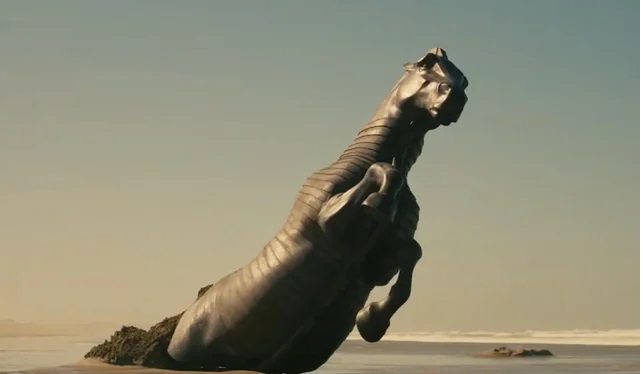
I was captivated by each part of it and how it unfolded. From the first adventure in the Cyclops’ cave to the stringing of the bow towards the end, I was frequently clutching the arm rests of my chair and sliding lower in my seat as the tense scenes played out. I allowed myself to be transported into this world of myths and magic and to get fully ‘invested’ (I hate this phrase). Chopping the timeline and revisiting a few scenes worked well for me. I often repeat myself when telling a story, so I had not issues seeing The Horse stuck in the sand more than once.

The film was 2 hours and 52 minutes long. I was not tempted to check the watch once. In fact, I wished it carried on a little longer. Unlike Christopher Nolan’s previous creation, Oppenheimer, 3 hours exactly, which felt torturously long. 

Matt Damon as Odysseus.

He was great. Deeply human, flawed, commanding, strong, angry, but also tender and vulnerable when he needed to be. His beard deserves a special mention, as it was his own throughout and it kept up with the choppy timeline, switching between short and black and long and grey, giving us heads up which point in the story we were at all times. 

The Horse. 

Beautiful departure from the more traditional version of it which used to place it on a square base with wheels. This one was bolting out of the sands outside Troy in the way that reminded me of the Statue of Liberty buried in the sand in the original Planet of the Apes. 

It is possible that I have watched too many movies. 

Tom Holland as Telemachus.

I loved what he did with the character. I had read opinions that he was too immature an actor to carry the role. I disagree; he was a young actor playing a young immature man, thrown into an overwhelming situation and he discharged the task perfectly. Am I biased? Perhaps. I am a big fan. 

Anne Hathaway as Penelope.

The weakest link for me. That does not mean she was bad, but she could have been better or perhaps she was slightly miscast or, I don’t know, she was just less perfect than this character could have been. 

Zendaya as Athena. 

I wanted to see more of her, I wanted to see her assume various human and animal forms, as per the original story, I wanted her to say more, to guide Odysseus and Telemachus more. It was not to be. Oh, well. 

The scene in which it looked like the bloodthirsty soldiers were about to kill her and then they decapitated her statue and her stone head rolled down the floor was one of my favourite images of the movie. 

Robert Pattison as Antinous (chief suitor).

He deserved all the praise the majority of reviews bestowed on him. He was devious, cruel, repeatedly sending the chills down the many spines in the audience. He was also charming with a perfectly pitched deceitful smile and the face reflecting his cold calculated nastiness. 

Samantha Morton as Circe.

She left me somewhat underwhelmed. Some reviews hinted at Oscar potential, I say she was okay, but not fantastic and also I feel her character was robbed of a significantly bigger importance in the original Homer story. I guess it’s a director’s prerogative to choose what to show and what to cut out  of the film, which was three hours long already. The story she was allowed to keep in the film, the turning of the men into pigs was done superbly. I was mesmerised from the moment the sailors’ eating manners slowly became foreboding. 

The music. By Ludwig Göransson. 

Beautifully complemented the story, ominous, powerful, always there, a

ways hitting just the right tone. I am largely musically illiterate, and hardly notice the music in some movies, but this time I did, and I savoured it.

Elliott Page as Sinon. 

Might have been confusing to Homer purists, as his character did not appear in the original Odyssey but only centuries later in Virgil’s The Aeneid, but his addition worked well and gave Odysseus another chance to reflect on the cruelty of war. 

Himesh Patel as Eurylochus. 

He was a long way from Albert Square. 

I loved his portrayal of Odysseus’s second in command, as somebody who often tried to temper his boss’s anger and pride with a little common sense. I knew he had to die but was hoping that maybe he won’t, he was such a likeable wise man. 

Zeus’ Law. 

This was mentioned so many times by so many characters it began to feel like an educational podcast on what it was and how important it was to the Greeks.

Charlize Theron as Calypso.

Lovely as always. Gorgeous and slender. Tender too. She made it totally understandable how Odysseus was persuaded to be kept captive by her for 7 years. Lotus flowers or not. 

The Sirens. 

I wanted to see more of them. I wanted to hear them sing. Instead, we had the unsettling piece of eery music.  Another ‘oh, well moment’. 

One Tiny Criticism. The very tiny raft.

The raft that Odysseus had built on Calypso island in a distinctively lackadaisical fashion was laughably inadequate to take him on the last leg of his journey. It was almost as if he didn’t care if it fell apart. Tom Hanks could teach him a lesson or two on how to construct a successful desert island getaway vessel.  

And Finally. 

A lot of people had got hot under the collar about the casting of a black actress, Lupita Nyong’o, as both Helen of Troy and her sister Clytemnestra. Lupita is on screen for less than 10 minutes. It’s a little more than a cameo. Although Helen of Troy is crucial to the story of the Trojan War, she is not terribly relevant to this story. The passionate online debate about this particular casting decision seemed totally over the top. 
Lupita was not the only non-white actor in the film, but she was the only one who had attracted racist abuse, as suddenly all the Homer experts became well-versed in the original text and questioned whether this face would indeed have been successful in launching a thousand ships. Her husband commented to visiting Telemachus in the film that perhaps now she could only launch five hundred ships, before Helen slowly turned towards us to reveal half of her face horribly scarred in the aftermath of the war. She still looked gorgeous though, she was still Lupita Nyong’o. 

Ithaca

“Odysseus, the king of Ithaca, left his home many years ago and has not returned. This is his story.”

This is the opening line of my debut book, The Odyssey, which I wrote at the age of 7.

It was inspired by the TV series of the same title, which was showing in Poland at the time. I loved the storyline, and started writing long before the brave Trojan War hero returned to the shores of his kingdom.

I felt I was onto something special, and hoped that nobody else would have the same idea and that I would be the only one who put it onto paper. When, two months later my parents told me that some guy called Homer had beaten me to it 28 centuries before, I sulked for a week.

Amelia and I stayed in Kefalonia for ten days earlier this month. Ithaca is a stone’s throw from Kefalonia, 45 minutes by ferry to be precise, so we knew it had to be done. We booked ourselves on a day trip to the tiny island and it was lovely.

Ithaca has no tourist resorts or sandy beaches to speak of, but it still attracts large number of visitors, mainly day-trippers like us, brought here on the strong winds of cultural, literary and historical snobbery.

Ithaca’s entire PR effort is geared towards Odysseus and Homer. The statues are everywhere. The port of Sami, where ferries to Ithaca depart from, features Odysseus Theme Park.

Our guide, Vanna, spoke pretty much non-stop. If I had a Euro for each time she described something as ‘gorgeous’, I could have probably paid for the pork souvlaki and Greek salad lunch for everybody on the coach. To be fair to Vanna, Ithaca is gorgeous.

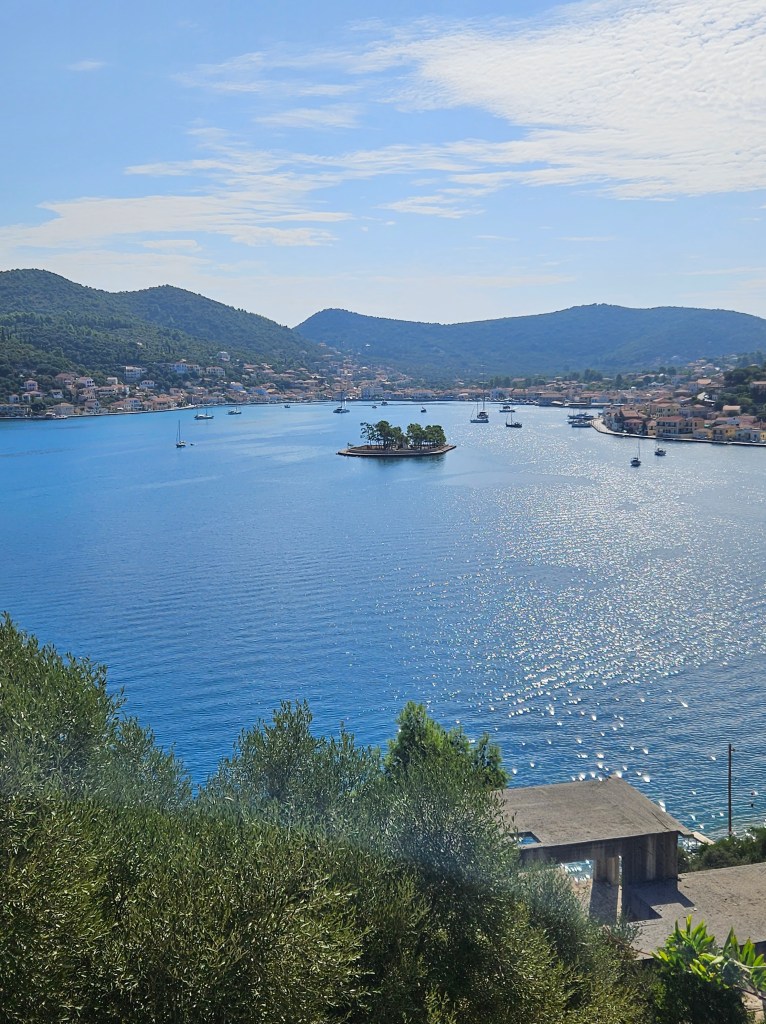
Our first stop was Vathy, the island’s capital. Amelia and I took a long walk around the bay, snapping happy as we went.

After that, it was a hairpin bend ascent to the Kathara Monastery, which offered us, yes, you guessed it, gorgeous views of the coastline.

Next stop was Kioni, for an unrushed lunch break. Kioni, like every other village in Ithaca, was a quaint little place, busy with sailboats coming and going at a steady pace.

Our final stop was Stavros, hailed as the Odysseus birthplace, but I had a strong suspicion we stopped there mainly so that Vanna was able to earn her commission from a local cafe. She herded us inside and gently nudged us towards the ‘local delicacy’, a rice and honey sweet called Rovani. It was an okay tasting rice pudding, which Amelia polished off happily.